
Touching Grass
Why the Best Brand Strategies Come From Observations In the Wild.

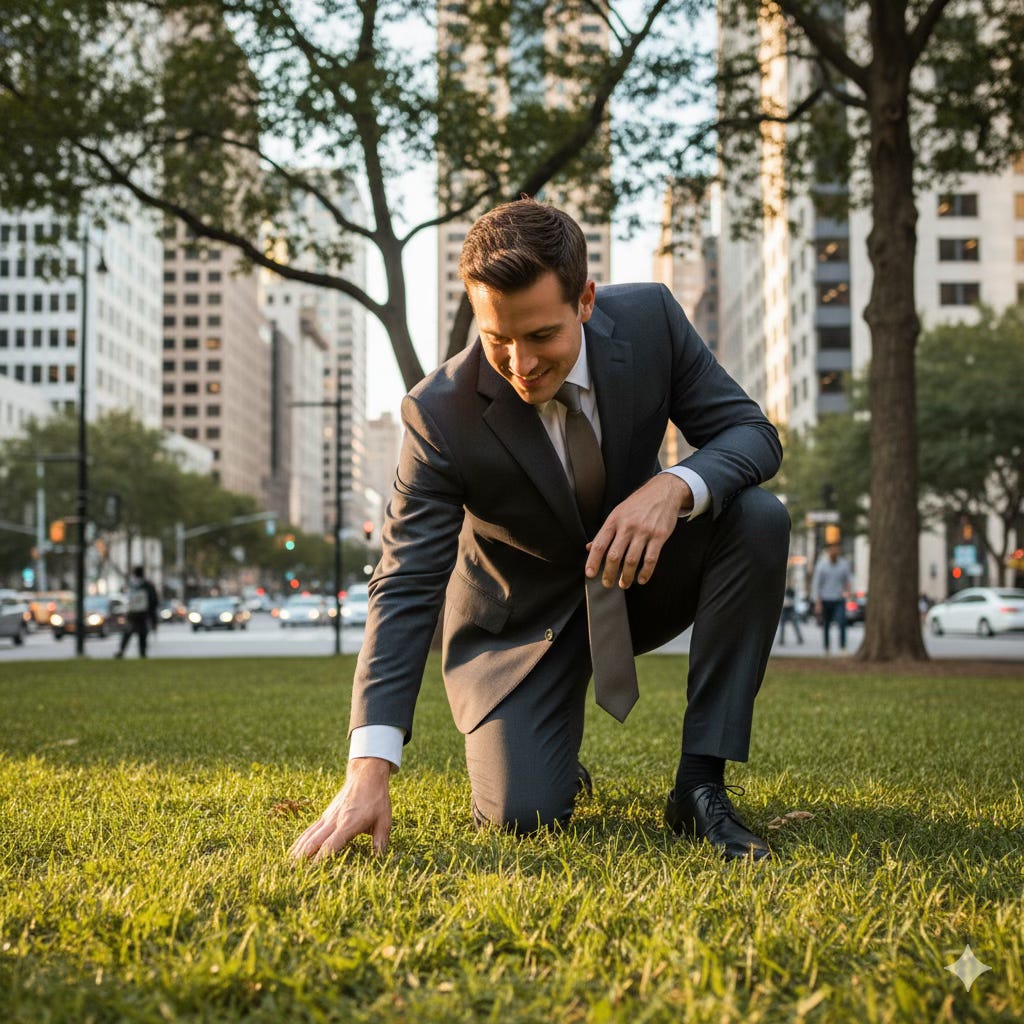
I learned the phrase “touch grass” from a scroll through social media last month. For those unfamiliar, it’s internet slang that essentially means “log off and reconnect with reality.” Usually deployed when someone’s take is so chronically online, so divorced from how actual humans think and behave, that the only prescription is to go outside and remember what the real world feels like.
I realized it might be the most essential brand strategy advice I’ve heard in years.
The Polling Problem
We’re facing the same crisis that’s currently breaking political polling. Younger generations don’t answer calls from unknown numbers. They don’t fill out surveys. They don’t participate in traditional research methodologies. They’ve opted out of being measured in the ways we’ve always measured people.
Yet here we are, building entire brand strategies on data collected from the shrinking percentage of the population that will talk to us.
Think about who actually completes your company’s customer satisfaction surveys. Who joins your brand community research calls? Who responds to your market research panels? Who participates in your focus groups?
It’s not a representative sample of your actual customers. It’s a highly self-selected group; the 5% who are professionally engaged with brands while we systematically miss the 95% who are just living their lives, making purchase decisions, and forming opinions without ever telling us about it.
This is what I was getting at in my recent piece about corporate severance and brand authenticity. We’ve created these elaborate systems for understanding consumers that are increasingly disconnected from actual consumer reality. We’re measuring what’s measurable rather than what matters.
The Conference Room Blind Spot
I’ve written before about how curiosity breeds creativity, how the best ideas come from relentlessly questioning the status quo. But there’s a prerequisite to asking good questions: you have to be looking at the right things.
And increasingly, we’re not.
We’re optimizing marketing strategies based on data from people who behave nothing like the majority of our customers. We’re building personas from focus group participants who had the time, inclination, and demographic profile to sit in a research facility for 90 minutes. We’re crafting messages tested against survey respondents who voluntarily give feedback to brands.
None of this is inherently wrong. But it’s incomplete in ways we rarely acknowledge.
The brands that genuinely resonate – the ones that feel like they actually get people – aren’t succeeding because they have better research panels. They’re succeeding because someone noticed something everyone else missed. Because they were watching actual human behavior instead of reading reports about human behavior.
What the Coffee Shop Taught Me
In my essay “Meet In the Commons,” I wrote about stumbling into a local coffee shop and realizing it had become something more than a transactional business. The owner had created a genuine community hub where connections flourished and people felt they belonged.
None of that insight came from a survey. It came from sitting there, watching, listening. Observing the unguarded moments when people think no one is paying attention to them as data points.
I saw how the barista greeted regulars by name, asked about their families. I watched strangers trade friendly banter at the communal table. I noticed the young couple debating their latest read, the friends who hadn’t seen each other in months embracing in that uniquely human moment of rediscovery.
These were insights about what people actually value: genuine connection, spaces where they feel recognized, environments that facilitate the kind of spontaneous human interaction that enriches daily life.
Would any of that have emerged from a focus group about coffee preferences? From a survey about café amenities? From journey mapping the “coffee shop customer experience?”
Perhaps it would’ve revealed fragments of the picture I saw. But it would have hidden or skewed the deeper truth about what was really happening.
The Anthropologist Advantage
I’ve argued before that marketers need to give themselves permission to pursue bold ideas, to trust hunches even when they can’t perfectly articulate why something feels right. But that permission is worthless if your hunches are based on abstracted data rather than observed reality.
The best brand strategists I know operate like anthropologists. They watch how people actually behave when they’re not being studied. They notice patterns in real environments. They understand that what people say they do and what they actually do are often two different things.
This isn’t some romantic notion about intuition versus data. It’s about recognizing that our most sophisticated data collection methods have significant blind spots – and those blind spots are growing.
When I designed campaigns like the Verizon x Inception mobile experience or deployed UGC as a commerce driver for GUESS back in 2012, those ideas didn’t come from research reports. They came from noticing how people were actually using their phones, how they were actually creating and consuming content, and what actually motivated them to engage.
The research helped validate and refine. But the insight came from observation.
The Unfiltered Truth
Here’s what makes “touching grass” so valuable: When you observe people in their natural environments, you see unfiltered behavior. No performance for the researcher. No trying to be a “good” focus group participant. No carefully considered responses to loaded questions.
Just humans doing human things.
This is where the most resonant brand strategies originate. Not from what people say matters to them, but from what their actual behavior reveals matters to them.
Robert Putnam wrote about social capital as “the connections among individuals’ social networks and the norms of reciprocity and trustworthiness that arise from them.” But he observed this by studying actual community participation, not by asking people survey questions about community.
The brands that truly understand community-led growth – that create genuine “coffee shop effects” – do so because they’ve observed how real communities actually form and function, not because they’ve read white papers about community management.
The Grass-Touching Challenge
So here’s my challenge, both to you and to myself:
When’s the last time you built a brand strategy based on something you noticed rather than something you measured?
When’s the last time you went where your customers actually are – not a research facility, but their actual environments – and just watched?
When’s the last time you prioritized unguarded human observation over sophisticated data analysis?
This isn’t about abandoning data or research. It’s about acknowledging that our measurement systems are increasingly capturing an unrepresentative slice of reality. And that the most valuable insights often come from the messy, unquantifiable act of paying attention to how real people really live.
Go to the grocery store and watch how people actually shop. Sit in a coffee shop and observe how they interact. Notice what they do on their phones while waiting in line. Pay attention to the small behaviors that reveal deeper truths.
Sometimes the most sophisticated brand strategy tool is your own eyes.
The best brand strategists are anthropologists first, analysts second.
Maybe it’s time we all touched some grass. 🌱